
Your AI assistant might be keeping you stuck in an older version of yourself.
Whether you're using ChatGPT, Claude, Gemini or Grok, memory and personalisation can shape the responses you receive. Having an AI that remembers your preferences, understands your business and learns how you work sounds incredibly useful. And often, it is. But what happens when you're trying to move beyond those preferences?
I encountered this while using ChatGPT to explore new personal messaging for Studio Riz. I wanted fresh ideas, different language and a chance to move beyond what I'd done before.
But something odd kept happening.
No matter how much I pushed, ChatGPT kept steering me back to familiar ground. I started recognising phrases and ideas from previous conversations, things I hadn't even mentioned in the new brief. That's when it clicked. AI memory was bringing my past into a conversation where I was deliberately trying to move beyond it.
The frustrating part was that the writing was often quite good. If I hadn't been pushing for something different, I probably would have accepted it.
How easily could someone fall into this trap without noticing?

When AI remembers too much
AI can recognise patterns in our conversations and identify information that might be useful later. But it can't reliably know which parts of our past we're trying to leave behind.
Just because I've used a phrase twenty times doesn't mean I want to use it again. Maybe I've changed my mind, outgrown that thinking or simply want to explore something different. Yet AI may continue recommending what it thinks I like.
Human memory works differently. We forget things, sometimes deliberately and sometimes without realising. Experiences fade, beliefs change and old ideas lose their importance.
Psychologists have studied the benefits of forgetting. In a review published in Perspectives on Psychological Science, Nørby (2015) examined how forgetting can help people regulate emotions, acquire knowledge and adapt to changing circumstances. Forgetting isn't simply a failure of memory. It can help us respond to the present without being overwhelmed by the past.
I find that fascinating. We spend so much time trying to remember more, yet forgetting can be just as important to our growth.
Something can be accurate about who you were and still be irrelevant to who you're becoming.
The most personal echo chamber yet?
We've seen how social media algorithms can reinforce our interests and beliefs. Engage with something on YouTube, TikTok or LinkedIn, and you're likely to see more of it.
AI memory introduces a similar risk, but one that's far more personal. We're asking AI to help us think, create and make decisions. When its responses draw on our previous conversations, familiar ideas can feel right simply because they sound like us.
And that's the trap. The suggestions aren't necessarily bad. They might even be quite good. But you could think you're discovering something new when you're actually being guided towards what you've already done.

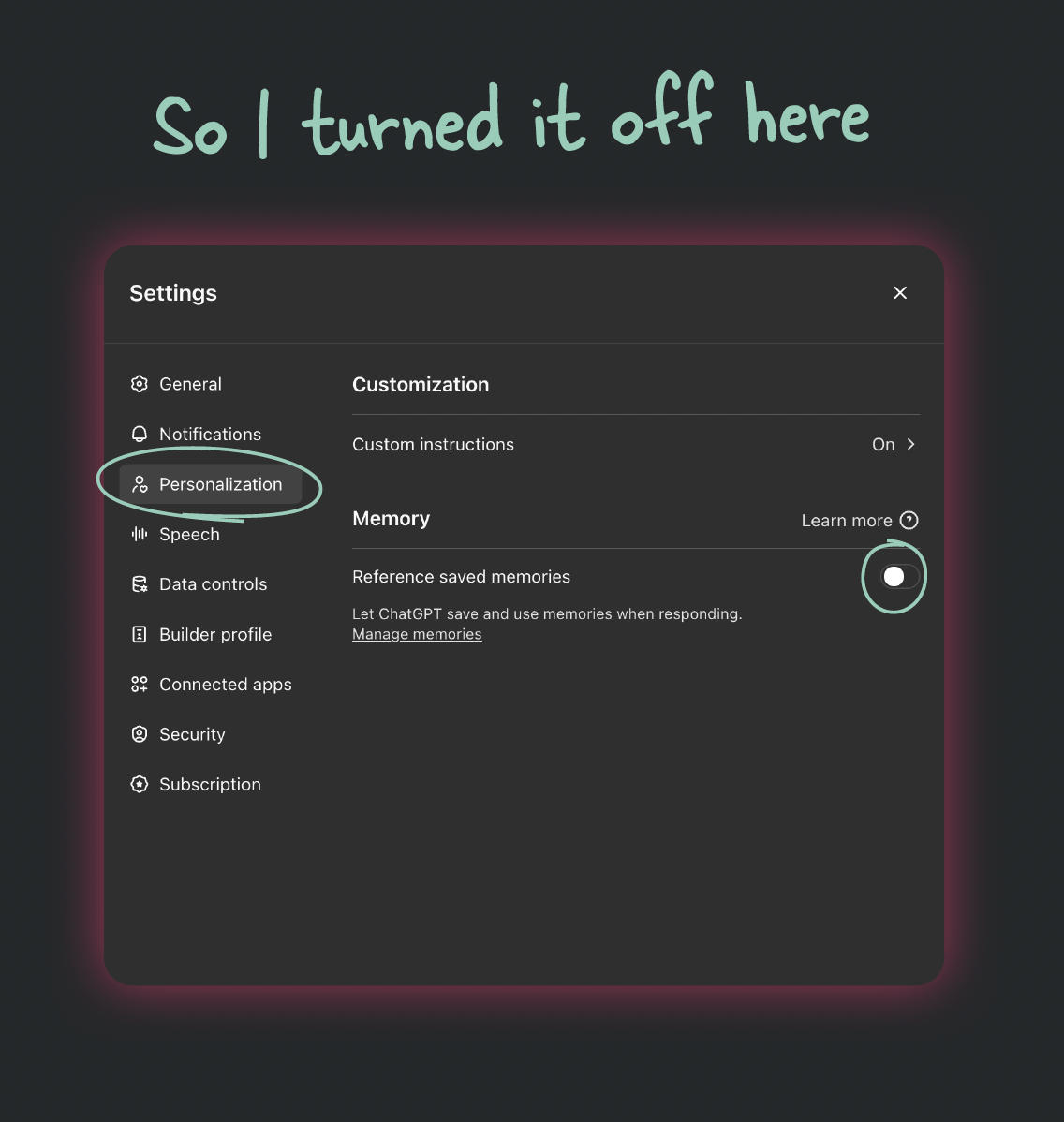
Take back control of your AI memory
I don't think we should abandon AI memory. It's useful when you need consistency or want to build on existing work. But we should be more deliberate about what AI gets to remember.
My approach has three parts: turn off persistent memory where possible, keep important context in documents I control, and choose when to share them.
Those documents might contain business strategy, brand guidelines, writing preferences or project information. When I need that context, I give it to the AI. When I want to challenge my existing thinking or explore something completely different, I leave it out.
There's real value in opening a new conversation with a fresh perspective. Just make sure you understand your AI's settings, because starting a new chat doesn't necessarily mean its memory is switched off.
Every AI model has its own tendencies, and we bring our own assumptions through the questions we ask. We can't eliminate every bias, but we can control how much of our past shapes the response. Sometimes that's enough to see something new.
I want AI to keep up with who I'm becoming, not keep bringing me back to who I was.
References
Nørby, S. (2015). Why forget? On the adaptive value of memory loss. Perspectives on Psychological Science, 10(5), 551–578. https://doi.org/10.1177/1745691615596787
Originally posted on LinkedIn: April, 2025
Updated: 7th November, 2026